
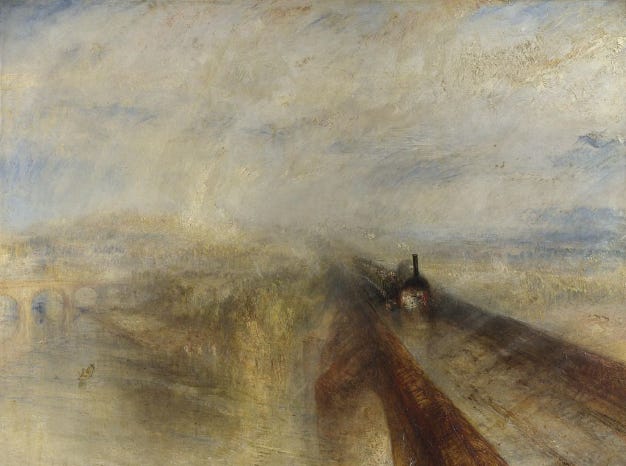
Rain, Steam, and Speed – The Great Western Railway (1844) by J. M. W. Turner does not represent the arrival of technology within the landscape; it renders the moment at which landscape itself becomes inseparable from motion. The painting is organized around conditions of velocity that dissolve the distinction between object, environment, and perception.
The structure of the image is unstable by design. A diagonal bridge cuts across the canvas, but rather than anchoring the composition, it channels movement into depth. The locomotive emerges from a dense atmosphere of rain and steam, its form only partially defined. It is visible, but never fully resolved—appearing less as a discrete machine than as a concentration of force moving through the field. The surrounding elements—river, sky, and distant terrain—do not frame this movement; they are drawn into it, losing their independence as stable forms.
Turner’s handling of light eliminates the clarity on which traditional landscape painting depends. Rain, vapour, and air merge into a continuous medium through which forms flicker in and out of legibility. The bridge persists as a faint structural guide, but even it recedes into the same atmospheric dissolution. Solidity is replaced by transition. The eye does not rest on fixed objects; it follows trajectories of motion that cannot be stabilized.
The small figure of the hare, running along the track ahead of the train, introduces a counterpoint that clarifies the transformation. Traditionally emblematic of natural speed, the animal is overtaken by the mechanical velocity of the locomotive. This is not staged as narrative drama but embedded as structural comparison. Two forms of movement occupy the same space, but no longer operate on the same terms. Nature continues, but it no longer defines the limits of speed.
Produced during the rapid expansion of the railway in nineteenth-century Britain, the painting reflects a shift in how space and time were experienced. Distance is compressed, and movement becomes continuous rather than episodic. Turner does not frame this shift as progress or disruption; he renders it as a reconfiguration of perception itself, in which the observer is no longer external to the scene, but immersed in its conditions.
Rain, Steam, and Speed replaces the stable landscape with a field structured by velocity. Technology does not enter this field as an addition; it generates it. The boundaries between natural process and mechanical force dissolve, producing a world in which motion becomes the primary organizing principle. In this formulation, civilization is not opposed to nature—it is carried forward in the same current, reshaping experience through speed rather than form.