
Painted around 1508, The Tempest by Giorgione presents a world in which meaning never fully settles into certainty. The painting does not narrate a recognizable event or anchor its figures within a stable story. Instead, it creates a scene suspended between suggestion and silence. What appears before the viewer is a condition to be experienced.
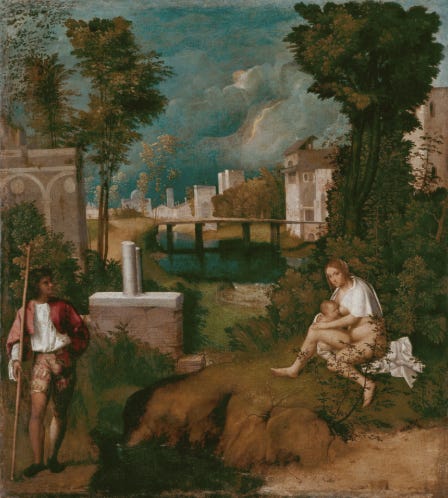
The composition is simple yet resistant to explanation. A man stands at the left. Across from him, a woman nursing a child sits beside a broken column. Between them runs a narrow channel of water that divides the scene with quiet precision. The figures share the same environment, yet no visible relation binds them together. They do not speak, gesture, or acknowledge one another. The distance between them is physical, but also interpretive. The painting refuses to explain why they occupy the same space at all.
Above them, a storm gathers across the sky. A flash of lightning cuts through the atmosphere—the sharpest moment in the painting and the only clear sign of movement. Yet even this moment clarifies nothing. The lightning does not trigger an event or reveal hidden meaning. Instead, it intensifies the instability already present throughout the scene; the tension exists not in a coming catastrophe, but in the atmosphere itself. The storm permeates the entire world of the image.
In the background, a city recedes into stillness. Its bridges, towers, and walls remain intact, but they no longer function as the centre of human activity. They appear distant from the immediate reality of the figures in the foreground, as though belonging to another order of time. Nature slowly overtakes structure. Grass, water, and sky absorb the built environment into a larger atmospheric field. The landscape encloses the figures within a world whose logic remains inaccessible.
This ambiguity reflects the intellectual culture of early sixteenth-century Venice, where painting increasingly aligned itself with poetry, mood, and suggestion rather than clear narrative explanation. Within humanist circles associated with figures such as Pietro Bembo, meaning was often understood as indirect and allusive—something evoked through atmosphere rather than declared. In this context, The Tempest marks a decisive shift within Renaissance painting. Unlike the structured clarity associated with Florentine design, Giorgione privileges tonal harmony, colour, and atmosphere over linear definition. The painting does not construct a clear argument. It sustains a state of feeling.
Giorgione does not produce an image that can be conclusively read. He produces a world that remains intact while withholding its final meaning—a world that invites entry, yet resists possession.