Form Without Object — Improvisation 28 (Second Version)
Abstraction, Structure, and the End of Representation

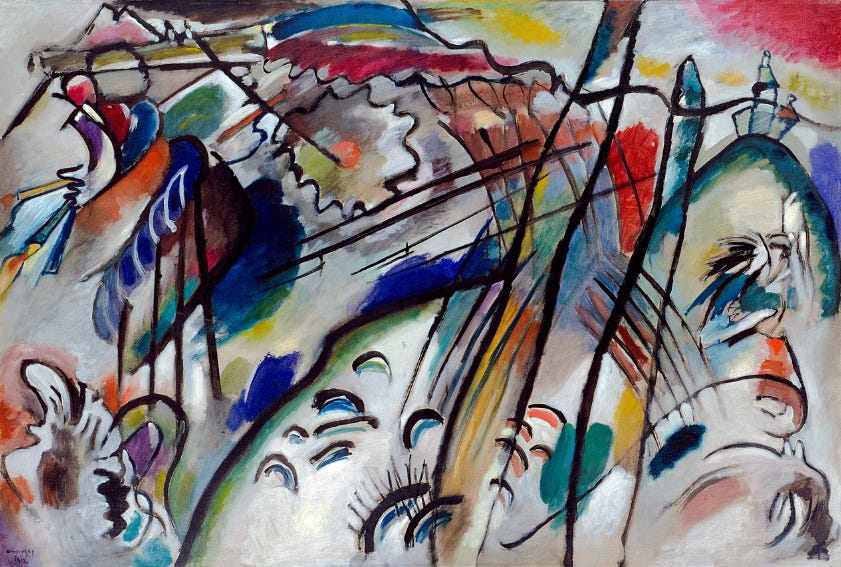
Lines surge across the surface without anchoring to recognizable forms. Colour gathers, disperses, and collides—blues pressing yellows, darker strokes cutting through lighter fields—while shapes emerge only to dissolve again into movement. The eye searches for stable reference points, but none hold. The composition advances through rhythm rather than depiction.
Improvisation 28 (Second Version) (1912) by Wassily Kandinsky abandons the expectation that painting must represent external objects. Instead, it constructs a visual field organized through internal relations—line, colour, and directional force. Elements do not describe a scene; they interact, forming a structure apprehended through movement rather than recognition.
The composition is neither random nor purely expressive in the sense of unmediated gesture. It is ordered, but that order is not immediately legible. Lines intersect at varying angles, producing zones of tension and release. Colour operates as an active force, directing how the eye moves across the canvas. Areas of density are countered by open passages, creating a shifting balance that resists fixation. The result is a system that can be entered at multiple points but not reduced to a single path.
Painted in 1912, the work belongs to a moment in which artists sought to move beyond representation toward what Kandinsky described as the expression of inner necessity. His theoretical writings, particularly Concerning the Spiritual in Art, argue that painting can function analogously to music, organizing experience through non-representational means. The term “improvisation” signals this orientation: not the absence of structure, but a form generated from internal principles rather than external models.
The painting is held today at the Solomon R. Guggenheim Museum, where it forms part of a broader collection tracing the emergence of abstraction. Its placement reinforces its status as a work that must be approached differently from representational painting. It does not offer a scene to interpret; it offers a structure to navigate.
Kandinsky’s approach aligns with broader developments in early twentieth-century thought, in which systems were increasingly understood in terms of internal relations rather than fixed representations. As he argued, colour and form possess their own expressive capacities, capable of producing effects independent of imitation. The image endures because it captures a decisive transformation: the moment at which painting ceases to be primarily about the visible world and becomes instead a field in which new forms of order are constructed from within.