
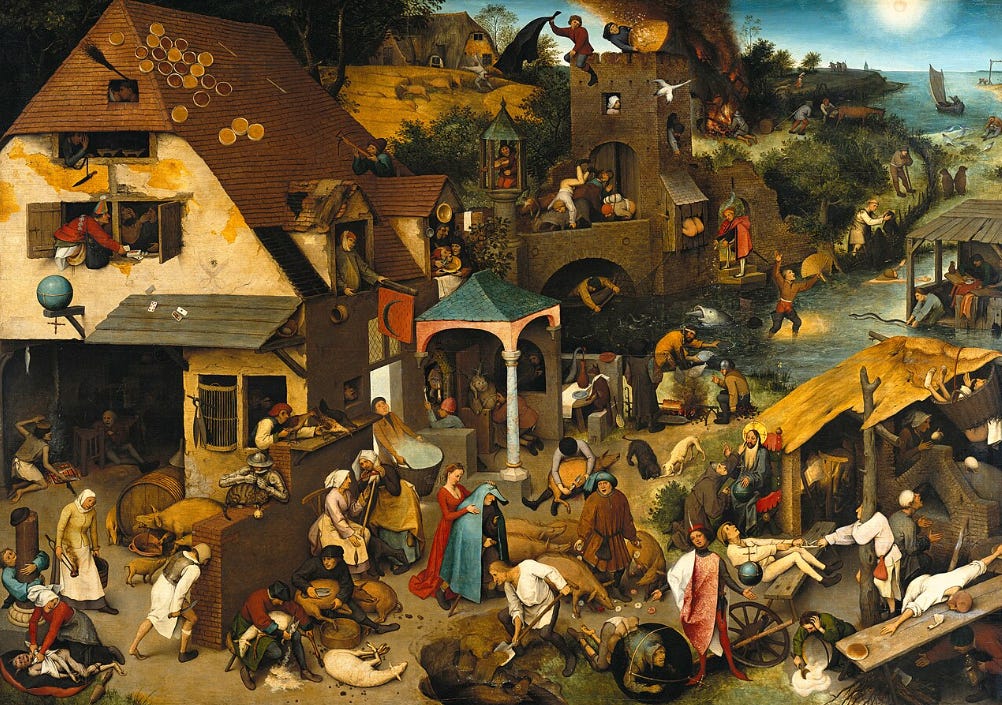
The Netherlandish Proverbs (1559) by Pieter Bruegel the Elder presents a world in which meaning is abundant but unstable. Rather than organizing a single narrative, the painting assembles dozens of proverbs into a continuous visual field, each rendered as a discrete action. The result is not coherence, but accumulation.
The composition resists hierarchy. Figures are small, evenly distributed, and engaged in self-contained acts—banging heads against walls, casting pearls before swine, enacting gestures that literalize familiar sayings. The eye circulates without settling. Local clarity does not produce global order; each scene is legible, but the whole does not resolve. This structure transforms wisdom into saturation. Proverbs, traditionally vehicles of shared understanding, multiply into contradiction. No single principle governs the scene.
Painted amid the social and religious tensions of the sixteenth-century Low Countries, the work reflects a culture in which inherited systems of meaning remained active but no longer aligned. Bruegel does not reject these systems; he exposes their limits. The figures are not outside civilization—they are fully within it.
The Netherlandish Proverbs presents civilization as a circulation of meanings that never fully stabilizes. Interpretation continues, but coherence remains provisional. The painting endures because it captures a condition in which understanding is always present, yet never complete.