
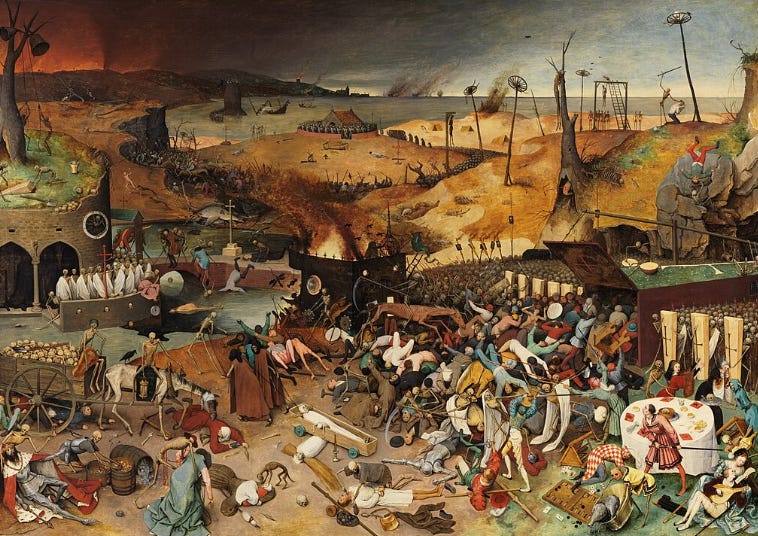
Painted around 1562, The Triumph of Death by Pieter Bruegel the Elder presents a world in which the structures of social life—warfare, labour, religion, and governance—are overtaken by a force that renders all distinctions meaningless. The painting does not depict a single event but a total condition, in which death operates as an organizing principle that overrides every form of human order.
The composition is expansive and densely populated, yet systematically structured. Armies of skeletons advance across the landscape, interacting with human figures from all social positions: soldiers, peasants, nobles, and clergy. No area of the canvas remains untouched, and no group is exempt. Scenes of violence, capture, and destruction are distributed across the surface, creating a visual field in which individual narratives are subsumed within a larger, coordinated movement. The effect is totalization—death as a system rather than an accident.
Bruegel painted the work in the context of sixteenth-century Europe, a period marked by religious conflict and recurring outbreaks of plague. The painting reflects a worldview shaped by these conditions, in which catastrophe was not exceptional. Drawing on medieval traditions such as the Danse Macabre, Bruegel extends the idea into a comprehensive vision, replacing symbolic representation with a detailed and continuous environment of collapse.
The painting is held today at the Museo del Prado, where it stands as one of the most complex and unsettling works of Northern Renaissance art. Its scale and detail invite prolonged examination, revealing new interactions and structures with each viewing.